
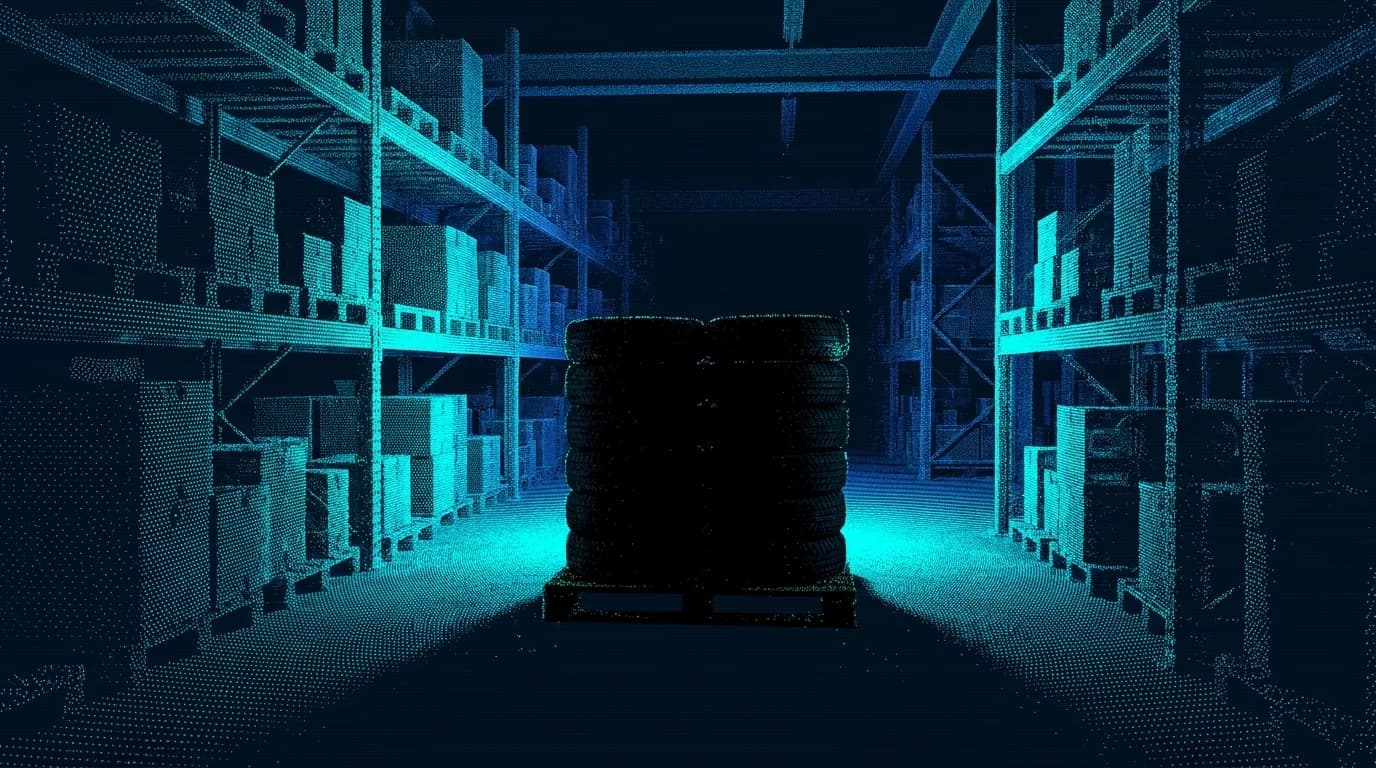
You've done everything right. Your AGV is spec'd with a safety LiDAR rated for 30 meters. The environment is controlled, the lighting is consistent, and the system passes acceptance testing with flying colors. Then someone rolls in a pallet of black rubber components, and your sensor starts behaving as if it simply isn't there.
This isn't a calibration error or a software bug. It's physics — and it's one of the most misunderstood performance factors in LiDAR sensor selection. If you're deploying autonomous systems in industrial environments, understanding how your sensor handles dark, matte, and low-reflective surfaces isn't optional. It's the difference between a system that performs in the real world and one that passes the demo.
The physics behind the problem
LiDAR operates on a straightforward principle: emit a laser pulse, measure how long it takes to return, calculate the distance. What the spec sheet often glosses over is what happens when the target doesn't cooperate.
Every surface has an albedo — its reflectivity across the light spectrum. LiDAR sensors typically operate in the near-infrared (NIR) range, around 905 nm or 1550 nm. Materials that appear dark to the human eye often absorb heavily in this same spectrum, leaving little to no return signal for the sensor to detect.
Two properties compound the problem:
- Absorption: Carbon black compounds — found in rubber flooring, tires, conveyor belts, and many industrial plastics — are specifically engineered to absorb light. A surface that absorbs 90% of the NIR signal leaves your sensor working with just 10% of what it needs.
- Diffuse scattering: Matte surfaces scatter light in all directions rather than reflecting it back toward the sensor. A dark matte surface combines high absorption with wide scatter — the worst possible combination for reliable detection.
A surface that looks "almost black" to the human eye may be nearly invisible to a NIR laser operating at 905 nm.
What "range" actually means — and when it doesn't
Here's what the spec sheet says: 250-meter range. Here's what that usually means: 250 meters against a white wall or a highly reflective target at 80%+ reflectivity. Against real-world dark surfaces, the story changes dramatically:
- A target at 10% reflectivity — fresh asphalt, dark clothing, rubber flooring — may reduce effective range to 50 meters or less on a sensor rated for 250 m.
- The signal return weakens by the inverse square of distance. A weak signal from a dark object hits the sensor's detection threshold much faster than a bright one.
- Below that threshold, the object simply doesn't appear in the point cloud — no warning, no partial detection. Just a void.
For warehouse automation and AGV applications, this matters immediately. If your system is operating in a facility with black conveyor belts, rubber-wheeled carts, or personnel in dark work clothing, the effective safety zone may be significantly smaller than your system was designed around.
The real-world consequence: gaps in the point cloud
When a LiDAR sensor fails to receive a sufficient return signal, the result is a void in the point cloud — a gap where an object actually exists. This isn't a cosmetic issue. In safety-critical automation, it's a functional hazard. Common scenarios where this becomes a problem:
- Black rubber floor transitions and dock bumpers in warehouse environments appear as open space to ceiling-mounted safety scanners.
- Dark-clothed workers or black-jacketed cables can go undetected at ranges that feel safe based on spec sheet numbers.
- Indoor 3D mapping applications miss dark features — black marble, rubber-coated stairs, dark machinery surfaces — leaving gaps in digital twin models.
- AGVs navigating environments with mixed-reflectivity flooring experience inconsistent detection distances depending on floor material and color.
How engineers work around low reflectivity
The good news: this is a well-understood problem, and there are proven approaches for addressing it — both in sensor selection and system design.
Sensor-level solutions
- Higher-sensitivity receivers: Sensors with more sensitive photodetectors can pull usable returns from weaker signals, extending effective range on dark surfaces.
- Dual-return and multi-echo processing: Advanced sensors capture multiple returns per pulse, helping distinguish weak surface returns from noise and improving detection reliability in challenging conditions.
- Wavelength selection: 1550 nm sensors generally perform better on dark surfaces than 905 nm sensors, though cost and eye-safety classifications differ between them.
- High-power emitters: More laser power means more photons to work with — even after significant absorption, enough returns to exceed the detection threshold.
System-level solutions
- Sensor fusion: Pairing LiDAR with radar (unaffected by surface reflectivity) or thermal cameras (detecting heat signatures regardless of color) ensures no object is truly invisible to the system.
- NIR-reflective coatings and pigments: New "cool black" pigments reflect NIR while appearing dark to the human eye. These are gaining traction in automotive and logistics for exactly this reason.
- Multi-zone safety configuration: When operating in known low-reflectivity environments, configuring more conservative safety zones compensates for reduced detection range.
- Floor and obstacle marking: In controlled environments, adding NIR-reflective tape or markers to known obstacles provides reliable detection anchors regardless of ambient surface reflectivity.
Selecting the right sensor for your application
When evaluating safety LiDAR or 3D perception sensors for environments where low reflectivity is a factor, ask your vendor the following:
- What is the rated range at 10% reflectivity, not just the maximum range?
- What is the minimum detectable reflectivity at your intended operating range?
- Does the sensor provide intensity data in the point cloud, or only distance?
- Has the sensor been tested against materials representative of your actual environment?
- What is the false-negative rate under low-reflectivity conditions at design range?
The bottom line
LiDAR is one of the most powerful perception technologies available for industrial automation — but its real-world performance is shaped by the reflectivity of the surfaces in your environment. Dark, matte materials are a legitimate challenge that deserves attention in the design phase, not a workaround discovered during commissioning.
Understanding the physics helps you ask better questions, spec more appropriate hardware, and build systems that perform reliably across the full range of conditions your environment presents. If you're working through sensor selection for an application where surface reflectivity is a concern, we'd be glad to walk through the specifics with you.